
Ayodhya Ram Mandir Ticket Price 2026
If you are checking the ayodhya ram mandir ticket price, the answer is simple: general darshan is currently free — there is no regular entry ticket to buy. The free Sugam Darshan system can also provide a scheduled entry, while aarti passes are separate and subject to availability. Recent visitor guides consistently report no paid VIP darshan, and the Shri Ram Janmabhoomi Trust has previously clarified that devotees should not pay for special entry.
The part that needs planning is not the ticket price. It is choosing your visit time, understanding the security procedure, and avoiding unofficial agents selling supposedly “VIP” passes.
Ayodhya Ram Mandir at a Glance
| What to know | 2026 planning information |
| Ram Mandir entry fee | Free |
| General darshan | Free; current arrangements may change |
| Sugam Darshan | Free, subject to current booking rules |
| Paid VIP darshan | No official paid VIP ticket |
| Location | Shri Ram Janmabhoomi, Ramkot, Ayodhya |
| Nearest major railway station | Ayodhya Dham Junction, roughly 2–2.5 km |
| Nearest airport | Maharishi Valmiki International Airport |
| Time to allow | At least 2–3 hours on an ordinary visit; longer on busy dates |
| Best general strategy | Early morning on a non-festival weekday |
The District Ayodhya administration lists Shri Ram Janm Bhumi Mandir among the city’s principal attractions, while the government tourism portal also identifies Ayodhya Dham Junction and Maharishi Valmiki International Airport as key access points.
Important: Temple schedules, entry arrangements, booking windows and security restrictions can change because of festivals, crowd levels or administrative orders. Check the official Trust portal or current temple instructions immediately before travelling.
What Is the Ram Mandir in Ayodhya?
The Shri Ram Janmabhoomi Mandir is the major temple complex at the site traditionally associated with the birthplace of Lord Ram in Ayodhya.
The present temple was consecrated in January 2024 and has rapidly become the centrepiece of pilgrimage in the city. The official District Ayodhya website identifies Sri Ram Janm Bhumi Mandir as one of the city’s major visitor attractions.
A visit is less like dropping into a small neighbourhood temple and more like entering a carefully managed pilgrimage zone. Security screening, walking routes, lockers and crowd-control arrangements are part of the experience.
What Is the Ayodhya Ram Mandir Ticket Price?
Is Ram Mandir entry free?
Yes. General darshan is free.
There is currently no standard admission ticket comparable to the paid entry tickets used at some monuments or tourist attractions. Recent 2026 visitor information also reports that the Sugam Darshan e-pass is free, rather than a premium ticket.
| Darshan option | Price | What it means |
| General darshan | ₹0 | Normal devotee entry |
| Sugam Darshan | ₹0 | Scheduled/managed darshan facility when available |
| Aarti pass | ₹0 | Separate limited-access arrangement |
| Paid VIP darshan | Not an official ticket | Be cautious of anyone selling one |
The important distinction is that free does not necessarily mean queue-free. A scheduled facility can make the process more predictable, but availability and procedures should be checked on the current official system.
Does Ram Mandir have a VIP ticket?
You should be extremely cautious if somebody approaches you with a “₹1,000 VIP pass,” “₹2,000 VIP darshan,” or similar offer.
The Trust previously stated that there was no arrangement for special darshan through payment of a fee or pass. Current 2026 travel guides likewise warn visitors against paying unofficial sellers for VIP entry.
In other words, don’t confuse a free Sugam Darshan arrangement with a ticket that somebody can sell you.
Ram Mandir Darshan Timings: When Can You Visit?
Published 2026 visitor information shows daytime darshan sessions with a midday break, but exact schedules can change. One current guide lists public darshan windows from around 7:00 AM onward, with a break around noon and evening sessions continuing into the night.
Because different travel sources currently publish slightly different schedules, I would not treat an internet timetable as permanent.
For the smoothest visit:
- Aim for an early morning arrival.
- Avoid Ram Navami and major festival dates if your priority is a shorter wait.
- Build extra time into weekend itineraries.
- Don’t schedule a train or flight immediately after darshan.
- Recheck the day’s instructions before leaving your hotel.
The broader Ayodhya tourism season is generally more comfortable from October through March, when temperatures are considerably easier for walking than during the peak summer months. UP Tourism notes that April–June can become extremely hot, while October–March is the more comfortable travel period.
How to Book Ram Mandir Sugam Darshan
The main thing to understand is that booking a pass and buying a ticket are not the same thing.
Current 2026 visitor information describes Sugam Darshan as a free, time-slot-based system intended to make the entry process more orderly.
A safer booking approach
- Start with the official Shri Ram Janmabhoomi Trust website/booking portal, rather than a tour operator’s website.
- Check the available date and current booking instructions.
- Enter the required devotee details.
- Save the confirmation/pass on your phone.
- Carry the identification requested by the current booking instructions.
- Arrive with enough time for security and the final walking approach.
Do not enter card details or send money to a website simply because it uses words such as Ram Mandir, Ayodhya, VIP, or official in its domain name.
District Ayodhya — official tourism information
For the latest Trust-operated booking instructions, use the Shri Ram Janmabhoomi Trust’s official portal and verify the domain carefully before entering personal information.
What Should You Expect During Ram Mandir Darshan?
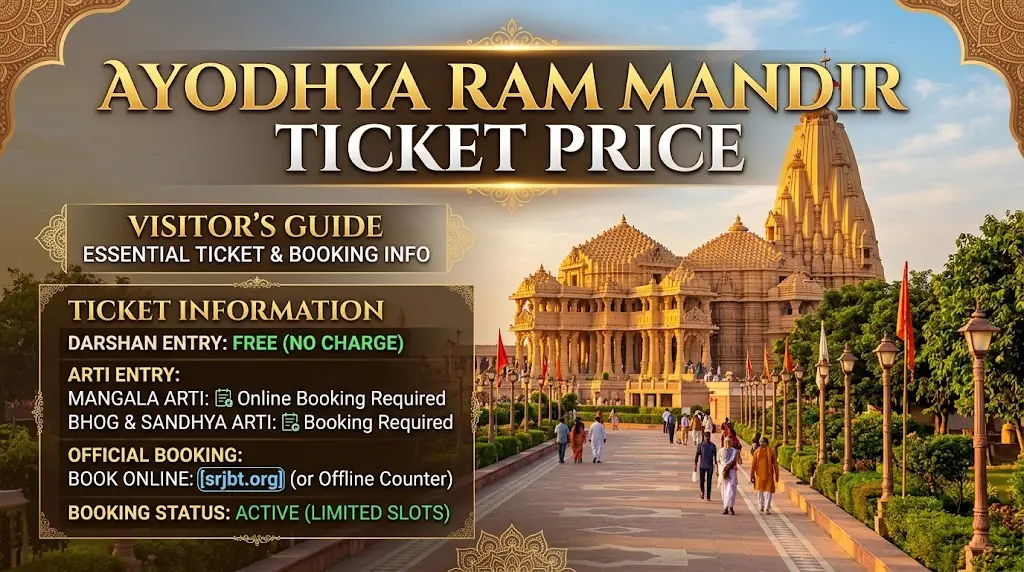
The biggest surprise for first-time visitors is often how much of the experience happens before you reach the temple itself.
You may walk considerably farther than expected because vehicle access around the most sensitive areas is controlled. Then comes security screening, the belongings/locker process and the organised movement toward the darshan area.
Don’t arrive carrying a backpack full of travel essentials and assume you can take everything inside.
Current visitor guidance says mobile phones, cameras and other electronic devices are restricted in the inner temple areas, with locker facilities available. A major locker-room expansion reported in February 2026 was designed to accommodate belongings from tens of thousands of devotees.
Local-style tip: wear simple slip-on footwear. You’ll save yourself unnecessary fumbling when footwear has to come off, and you won’t want to be carrying a complicated bag through a crowded pilgrimage route.
And don’t plan your visit around getting photographs of Ram Lalla. Photography restrictions apply inside the controlled areas. Keep your camera for the architecture and permitted outdoor areas instead.
Ram Mandir Rules, Safety and Accessibility
Security is taken seriously, so the easiest strategy is to travel light.
What should you leave behind?
Current visitor guidance commonly advises against taking the following into controlled areas:
- Mobile phones and cameras
- Smartwatches and other electronics
- Large bags and backpacks
- Sharp objects
- Tobacco and similar prohibited items
- Food items where prohibited by current security instructions
Rules can change, so follow the instructions displayed at the entrance rather than relying on an old packing list.
What about elderly visitors and wheelchair users?
Ayodhya has added accessibility facilities as pilgrimage infrastructure has expanded. Current 2026 visitor information reports wheelchair assistance and mobility support around the temple area, although the exact availability and any helper arrangements should be confirmed before arrival.
If you’re travelling with an older family member, don’t treat the railway-station-to-temple distance as the whole mobility challenge. The walking, security queues and time spent standing can matter more than the map distance.
Ask staff about the current accessible route as soon as you reach the temple area.
How to Reach Ram Mandir in Ayodhya
Ayodhya is much easier to reach than it was before the temple’s construction transformed the city’s visitor infrastructure.
| Starting point | Approx. distance | Practical option |
| Ayodhya Dham Junction | ~2–2.5 km | E-rickshaw, auto or walk |
| Ayodhya Cantt | ~8–10 km | Auto/taxi |
| Maharishi Valmiki International Airport | ~10–15 km depending on route | Taxi/cab |
| Lucknow Airport | ~135 km | Taxi or onward train/road |
| Ram Ki Paidi | ~1.5–2 km | Walk/e-rickshaw |
Distance figures vary between sources because the exact drop-off point and restricted road sections can change. Ayodhya Dham Junction is generally the most convenient railway arrival point for Ram Mandir; current guides put the temple roughly 2 km away.
The government tourism portal also confirms Ayodhya Dham Junction and Ayodhya Cantt as the city’s major railway access points.
UP Tourism — Ayodhya travel information
Nearby Attractions to Combine With Ram Mandir
You don’t need to spend an entire day standing in a temple queue. Ayodhya’s most interesting sights are close enough to combine into a walking-and-rickshaw itinerary.
Hanuman Garhi
Start or finish your temple circuit at Hanuman Garhi, one of Ayodhya’s best-known religious sites. The District Ayodhya website places it about 1 km from the railway station.
Kanak Bhawan
Kanak Bhawan is particularly easy to combine with Ram Janmabhoomi because it is in the same central temple district. The official district tourism page describes it as one of Ayodhya’s famous historic and religious temples.
For your site’s internal linking, useful companion pages would be:
- Hanuman Garhi Ayodhya Guide
- Kanak Bhawan Timings & Entry Guide
- Best Places to Visit in Ayodhya
- Complete Ayodhya Travel Guide
Ram Ki Paidi and the Saryu
Finish around the Saryu rather than rushing straight back to your hotel. Ram Ki Paidi is a series of riverfront ghats and is one of the best places to slow down after the structured pace of the temple visit. The District Ayodhya tourism site lists it among the city’s principal religious attractions.
The atmosphere changes noticeably toward evening, especially when the riverfront begins to glow with lamps.
Sample One-Day Ayodhya Budget
Since the Ram Mandir entry itself costs ₹0, most of your spending goes toward getting around, food and accommodation.
A reasonable budget-planning framework for one person could look like this:
| Expense | Budget to allow |
| Ram Mandir general darshan | ₹0 |
| Local e-rickshaw/auto rides | ₹100–₹300 |
| Breakfast | ₹50–₹120 |
| Lunch | ₹100–₹200 |
| Evening tea/snacks | ₹50–₹100 |
| Prasad/offerings | ₹100–₹300 |
| Miscellaneous | ₹100–₹200 |
| Approx. local-day budget | ₹500–₹1,200 |
These are planning allowances, not official fixed fares. Transport prices, food choices and offerings vary, particularly during festivals and high-demand periods.
If you’re staying overnight, add your hotel cost separately. Likewise, intercity train or flight costs can dwarf the actual cost of visiting the temple.
What Surprises First-Time Visitors Most?
Three things tend to catch people off guard.
First, the free entry doesn’t mean zero waiting. The cost is ₹0, but your time is the real resource.
Second, the final approach can feel longer than the map suggests. Road restrictions and pedestrian movement mean that being “2 km away” does not mean you will be dropped directly beside the sanctum.
Third, travelling light makes an enormous difference. Trying to enter with phones, bags and unnecessary electronics adds another step to an already structured process. The expanded locker infrastructure is useful, but leaving valuables at your hotel is still the simplest option when practical.
The best Ram Mandir visit is usually not the one with the most elaborate package. It is the one where you arrive early, carry little, leave plenty of time and don’t let an unofficial agent turn a free darshan into an expensive one.
Frequently Asked Questions
Is the Ayodhya Ram Mandir ticket price free in 2026?
Yes. General darshan at Shri Ram Janmabhoomi Mandir is currently free, with no regular admission ticket. Current 2026 visitor information also reports free Sugam Darshan arrangements.
Is there a paid VIP darshan at Ram Mandir?
There is no official paid VIP ticket that visitors should purchase. The Trust has previously clarified that special darshan cannot be obtained by paying a fee, so be very cautious about agents selling “VIP” passes.
Do I need a ticket for Ram Mandir darshan?
You do not need to buy an entry ticket for normal darshan. Depending on the current system, you may use a free scheduled/Sugam Darshan facility, but check the latest instructions before travelling.
How can I book Sugam Darshan at Ram Mandir?
Use the current official Shri Ram Janmabhoomi Trust booking system and follow its date, identity and slot instructions. Do not pay a third party simply to obtain a supposedly VIP or fast-track ticket.
What is the best time to visit Ram Mandir?
Early morning on a normal weekday is generally the better choice if your priority is avoiding the heaviest crowds and daytime heat. Festival periods such as Ram Navami can be dramatically busier.
Can I take my mobile phone inside Ram Mandir?
Current visitor guidance says phones and cameras are restricted in the controlled temple areas. Locker facilities are available, but policies can change, so check the latest instructions before entering.
How far is Ayodhya Dham Junction from Ram Mandir?
It is roughly 2–2.5 km, depending on the route and the particular temple access point. Walking takes longer than the distance might suggest because of pedestrian routing and crowd conditions.
How much time should I keep for Ram Mandir?
For planning purposes, allow at least 2–3 hours rather than treating it as a 30-minute sightseeing stop. Busy weekends, holidays and festivals can require substantially more time.
Conclusion: Ram Mandir Darshan Doesn’t Have to Be Expensive
The headline answer is reassuring: Ayodhya Ram Mandir darshan is currently free. Your bigger costs are travel, accommodation, food and your time — not an admission ticket.
Arrive early, keep your belongings to a minimum, follow the latest security instructions and never pay an unofficial seller for a “VIP” pass. Before setting out, verify the current darshan schedule and booking arrangements through official channels because temple operations can change for festivals, security reasons and crowd management.
If you’re planning a complete pilgrimage, combine Ram Mandir with Hanuman Garhi, Kanak Bhawan and an evening visit to Ram Ki Paidi. That gives you a much fuller sense of Ayodhya than visiting the temple alone.