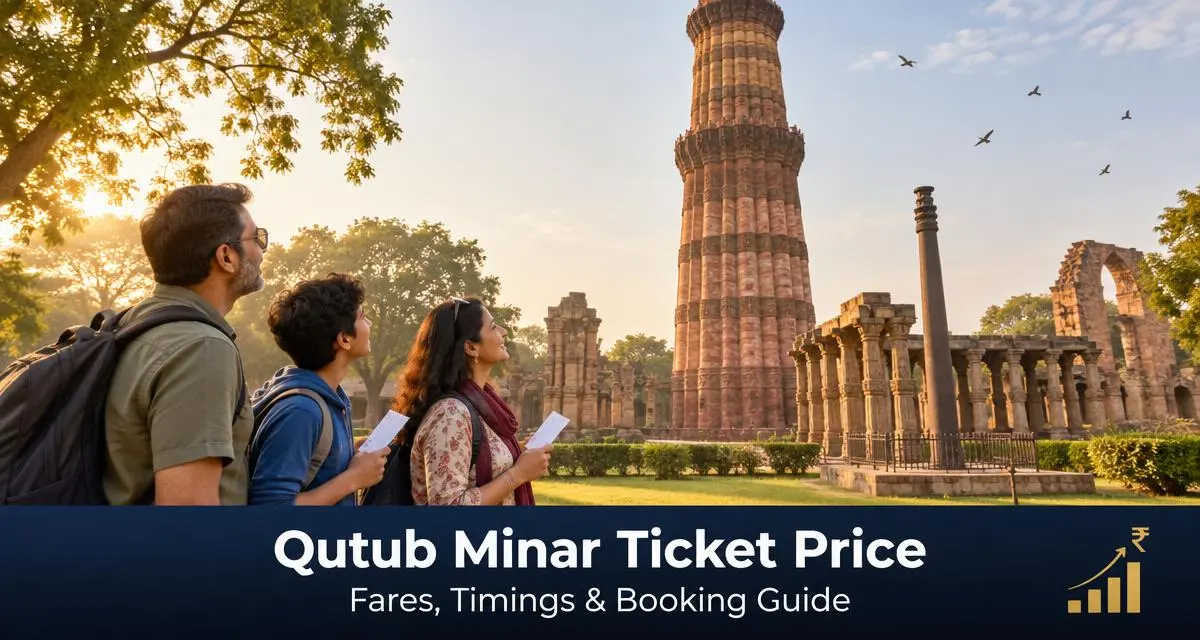
Qutub Minar Ticket Price 2026: Entry Fee, Timings & Online Booking
Planning a visit to Delhi’s most famous monument? Here is the short answer: entry to Qutub Minar costs ₹35 for Indian adults when booked online (₹40 in cash at the counter) and ₹550 for foreign tourists online (₹600 in cash). Children under 15 enter free. The monument is open every day of the year, and buying your ticket on your phone takes two minutes, no long queue needed.
This guide covers the full ticket prices, what’s included, timings, online booking, the nearest metro, what to see inside, and a few tricks most travel blogs never mention.
Qutub Minar at a Glance
| Item | Details |
| Entry fee (Indian adult) | ₹35 online / ₹40 cash at counter |
| Entry fee (foreign tourist) | ₹550 online / ₹600 cash at counter |
| Children below 15 | Free |
| Timings | 7:00 AM to 5:00 PM, all days |
| Location | Mehrauli, New Delhi (UNESCO World Heritage Site) |
| Time needed | 1.5 to 2 hours |
| Nearest metro | Qutub Minar station, Yellow Line (~2 km) |
Note: Monument fees can change. The prices above are the latest confirmed rates (2026). Always check the ASI board at the entrance or the official ASI website before planning around exact figures.
What Is Qutub Minar?
Qutub Minar is a 72.5-metre brick minaret in Mehrauli, South Delhi, built in 1192 by Qutb-ud-din Aibak, the founder of the Delhi Sultanate. It is the tallest brick minaret in the world and a UNESCO World Heritage Site.
The complex around it holds the first mosque built in India, a 1,600-year-old rust-free iron pillar, and several tombs so your one ticket actually covers a full half-day of history.
Qutub Minar Ticket Price: What’s Included
One entry ticket covers the entire Qutub complex — the minar, Quwwat-ul-Islam Mosque, Iron Pillar, Alai Darwaza, tombs, and gardens. There is no separate charge for still photography.
| Ticket type | Online price | Cash price (counter) | What’s included |
| Indian adult | ₹35 | ₹40 | Full complex entry |
| Foreign tourist | ₹550 | ₹600 | Full complex entry |
| SAARC/BIMSTEC citizen | ₹35 | ₹40 | Full complex entry |
| Children below 15 | Free | Free | Full complex entry |
| Video camera (non-commercial) | ₹25 | ₹25 | Add-on at gate |
Three things worth knowing about the ticket itself: it’s valid about 3 hours from entry (plenty, but don’t dawdle at the gate), you may need a photo ID at the counter, and still cameras are free — only video cameras attract the ₹25 add-on.
For context on how monument and attraction pricing compares across India, see our Science City ticket price guide.
Timings & Best Time to Visit
Qutub Minar is open 7:00 AM to 5:00 PM every day, including weekends and public holidays. The official ASI rule is “sunrise to sunset.” After sunset, the monument is illuminated with LED lights (roughly 7 PM to 9 PM), and evening visitors have separate night-viewing arrangements checked locally, as night timings can shift with the season.
The best time to visit is October to March, when Delhi’s weather is pleasant (12–20°C). Arrive at opening time in winter, or late afternoon in summer, to avoid both the heat and the school-bus crowds. The minar glows gold at sunrise and sunset. The best photos happen in the first or last hour of the day.
Light & sound show: A light-and-sound show has run at the complex in recent years, telling the story of Delhi’s history. Show timings shift with sunset (roughly 6:30 PM in winter, 7:30 PM in summer), and in recent seasons it has been included with the entry ticket rather than sold separately. Since the schedule changes seasonally, confirm at the gate on the day of your visit this Qutub Minar guide with light-show timings tracks the current schedule.

How to Book Tickets Online
Booking online saves both money and waiting time digital tickets are ₹5 cheaper for Indians and ₹50 cheaper for foreigners. This online discount was introduced by the Ministry of Culture to promote shorter queues and night tourism.
- ASI’s official e-ticket portal: Search for the Archaeological Survey of India’s official online ticketing portal (run on the ASI ticketing system). Select “Qutub Minar, Delhi,” pick your date, and pay digitally. Show the e-ticket/QR at the gate.
- QR codes at the gate: ASI has placed QR-code standees near the entrance. Scan one with your phone, pay online, and walk in at the discounted ₹35/₹550 rate — the same price as booking ahead.
- On the counter: Cash counters sit just outside the main entrance, across the road. Cash costs slightly more (₹40/₹600).
Caution about third-party sites: Many travel websites sell “Qutub Minar tickets” bundled with tours at inflated prices. If all you want is entry, use the official ASI channel only it takes the same two minutes and costs the least.
How to Reach Qutub Minar
| Mode | Details |
| Metro | Qutub Minar station, Yellow Line — then a 10–12 minute walk, e-rickshaw, or sharing auto (₹20/person) |
| From IGI Airport | ~12–15 km by road; 35–45 minutes by cab (metro + auto is cheaper) |
| From New Delhi Railway Station | ~16–18 km; take the Yellow Line to Qutub Minar station. If you need reservation help for train travel, our Tatkal ticket price guide covers booking charges. |
| By bus | DTC buses connect Mehrauli to most parts of Delhi |
| By auto/cab | Easily available; fix the fare on the meter before starting |
The nearest railway station is Hazrat Nizamuddin / New Delhi depending on your direction; Old Delhi (Chandni Chowk) is about 20 km away.
What You’ll See Inside the Complex
Walk in through the main gate and the first thing that hits you is scale the minar’s five tapering stories of red sandstone shoot straight up for 72.5 metres. Public access to the interior stairs has been closed since 1981, so you view it from the gardens honestly at a better angle anyway.
Then work your way through the complex in this order to beat the crowds (more on this below):
- Quwwat-ul-Islam Mosque: The first mosque built in India (1192). Its tall carved arches frame perfect photos of the minar behind them.
- Iron Pillar: A 7-metre, 6-ton pillar from the 4th century CE that has not rusted in over 1,600 years, thanks to its high phosphorus content. It’s fenced now, so the old “hug it for luck” ritual is out — the metallurgy is still worth the stop.
- Alai Darwaza: The red-and-white stone gateway built by Alauddin Khalji. Look up at the dome — one of the earliest true domes in India.
- Alai Minar: The stump of an unfinished tower meant to be twice as tall as Qutub Minar. It never got past the first story a medieval “what if.”
- Tombs of Iltutmish and Alauddin Khalji: Quiet, shaded corners most visitors walk past. The Iltutmish tomb’s carved interior is worth the detour.
Rules & Safety to Know
- No climbing. The minar’s 379 interior stairs have been permanently closed since a 1981 stampede tragedy. This is non-negotiable and enforced.
- Prohibited: Food and drinks (water is allowed), smoking, tobacco, large backpacks, and drones. Small bags and cameras are fine.
- Respect the prayer area: The Quwwat-ul-Islam mosque area can be used for prayer — keep voices low.
- Beware of touts: Guides and “official photographers” swarm the parking area. Agree on the price before starting.
3 Things Most Guides Won’t Tell You
- Foreign tourists get a separate, faster counter. If you are a foreign visitor, skip the main Indian queue entirely. Your counter is shorter and moves quicker. This single tip can save 20–30 minutes on a weekend.
- Walk the complex in reverse. Almost everyone starts at the minar and shuffles forward with the crowd. Start instead at the Alai Minar end and work back toward the minar — you will get clear photos at every stop.
- The minar end empties out after 4 PM. The last hour before closing is the quietest time of the day, and the winter light at 4–5 PM is the best for photos.
- No footwear restrictions here. Unlike temples and mosques, the Qutub complex has no shoe rules. Wear comfortable walking shoes, because you will cover a lot of ground across lawns and stone paths.
Nearby Attractions
Extend your day with these, all within 30 minutes:
- Mehrauli Archaeological Park (adjacent) spread across 200 acres, with tombs, stepwells, and the historic Jamali Kamali Mosque. Free entry.
- Hauz Khas Village & Deer Park (~20 min) a 14th-century water tank complex with trendy cafés above the ruins.
- Lotus Temple (~25 min) the Baháʼí House of Worship shaped like a lotus; free entry, closed on Mondays.
- Garden of Five Senses (~10 min) landscaped gardens perfect for an evening stroll after the monument closes.
Sample One-Day Budget (Per Person)
| Expense | Cost |
| Entry ticket (Indian, online) | ₹35 |
| Metro (round trip, Delhi) | ₹40–₹60 |
| Auto/e-rickshaw to gate | ₹20–₹40 |
| Guide (optional, shared) | ₹100–₹200 |
| Lunch/snacks | ₹200–₹400 |
| Water/refreshments | ₹50 |
| Total | ≈ ₹450–₹750 |
For foreign tourists, swap in the ₹550 ticket and add guide/cab costs a comfortable full day run around ₹1,500–₹2,500 including a private cab.
FAQs
What is the Qutub Minar ticket price in 2026?
Indian adults pay ₹35 online or ₹40 in cash at the counter. Foreign tourists pay ₹550 online or ₹600 in cash. Children below 15 years enter free, and SAARC/BIMSTEC citizens pay the Indian rate.
Can I book Qutub Minar tickets online?
Yes. Book through the Archaeological Survey of India’s official e-ticket portal, or scan the QR codes displayed at the entrance gate — both give you the discounted online price (₹35/₹550) without standing in the cash queue.
What are Qutub Minar’s timings?
The monument is open daily from 7:00 AM to 5:00 PM. After sunset it is illuminated, and night-viewing arrangements vary by season, so check at the gate for evening access.
Which metro station is nearest to Qutub Minar?
Qutub Minar station on the Yellow Line. From there it’s a 10–12 minute walk, or take a sharing auto (₹20/person) or e-rickshaw to the gate.
Is the Qutub Minar light and sound show free?
In recent seasons the evening show has been included with the regular entry ticket rather than sold separately, but timings shift with sunset (roughly 6:30 PM in winter, 7:30 PM in summer). Confirm the day’s schedule at the entrance.
Can I climb inside Qutub Minar?
No. The interior stairs have been permanently closed to the public since 1981 for safety reasons. Visitors explore the surrounding complex instead.
Are children charged entry?
No. Children below 15 years of age enter free of charge.
How much time do I need at Qutub Minar?
Plan 1.5 to 2 hours for the full complex — the minar, mosque, Iron Pillar, Alai Darwaza, tombs, and gardens.
Conclusion
At ₹35 for Indians less than a cup of coffee Qutub Minar remains one of the best-value heritage visits in India. Go on a winter morning or a late afternoon, book on your phone, walk the complex in reverse, and give the Iron Pillar the full two minutes it deserves. Delhi has seen 800 years of history from this spot; your ₹35 ticket buys you an afternoon of all of it.